Cardiac arrest survivor meets the team who saved his life
A Bedlington man will have the opportunity to celebrate his birthday and Christmas with his family this month thanks to the fast actions of the people who came to his aid when he collapsed in the street.
Peter Routledge, aged 72, was walking to the bus stop at Bedlington station for a dental appointment on 29 October when he suffered a cardiac arrest.
Quick-thinking members of the public came to his aid, seeking assistance from North East Ambulance Service (NEAS) via 999 as well as additional help from the workers on the building site across the road until the crews arrived.
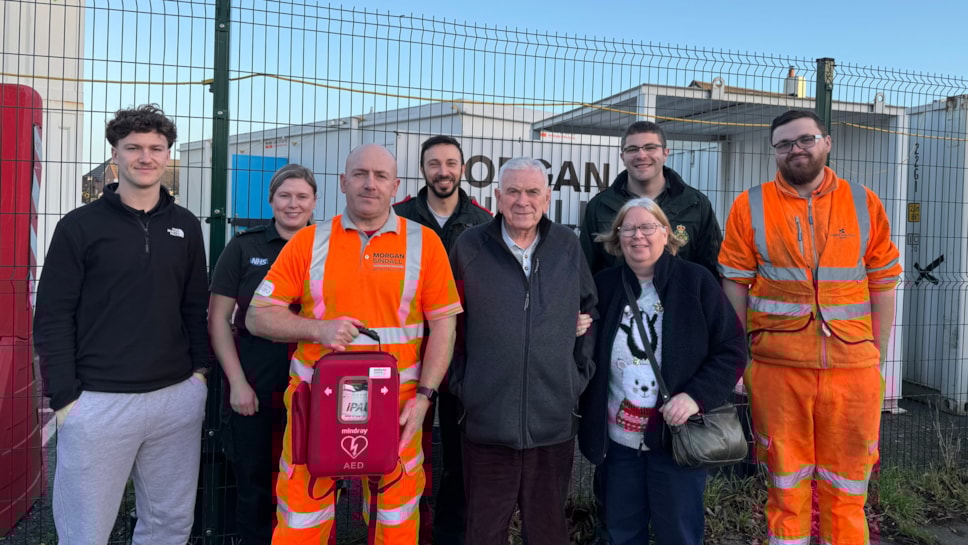
Thanks to the fast actions of all involved, Peter is making a fantastic recovery, and has now been able to meet back up with the people who saved his life.
When a cardiac arrest strikes, chest compressions provided during CPR pump blood around the body to keep someone alive until the ambulance crew arrives. Without immediate treatment with CPR and a defibrillator, the person’s chance of survival reduces every minute.
Although there is a community public access defibrillator near where Peter collapsed, it was unavailable due to being vandalised on the day Peter collapsed.
Luckily, all building sites operated by Morgan Sindall Infrastructure, the firm in charge of the work on Bedlington Station as part of the Northumberland Line Project, have defibrillators on site.
With support from NEAS health advisor Dawn Hudspith, general foreman Clive Goffatt carried out CPR and used the site’s defibrillator until the arrival of Blyth ambulance crew Matthew Sanderson and Michael Ashbridge.
Minutes later, they were backed up by a NEAS clinical team leader, Mark Walker, and a second ambulance crew, Megan Carter and Bogdan Volindan.
Together, they were able to resuscitate Peter and transport him to Northumbria Specialist Emergency Care Hospital (NSECH) for further treatment.
Peter was initially spent just over a week in the critical care unit in an induced coma before having an implantable cardioverter defibrillator (ICD) fitted to prevent any further heart issues going forward.
The retired maintenance technician is now home and looking forward to celebrating his 73rd birthday with his loved ones on 20 December.
“I can’t remember anything, not even leaving the house that morning,” said Peter. “The first thing I was remember was waking up in hospital.
“I do have a heart history but I’m generally fit and well and had felt fine that morning and the days leading up to it, there was no warning whatsoever.
“It’s just not something you expect to happen. I wouldn’t know what to do if someone collapsed, it’s amazing really to think how everyone responded. I feel really lucky, but this isn’t about me, it’s about the people who saved me.”
Owen Carr, assistant site engineer, was making his way to the site when he spotted Peter on the ground with people standing next to him. He immediately got help from the team in the site office and arranged for a neighbour to move their car to enable to ambulance to get in, whilst his colleague Sam Little stopped and diverted traffic.
One of that team was general foreman Clive Goffatt. He said: “We grabbed the first aid kit and defib and took off down the street. We were faced by a lady carrying out CPR and people on the phone to the emergency services.
“When we got to Peter, his breathing was irregular and I could see from the colour of his skin and lips that something wasn’t right. After listening to his chest, I got the defib out and put it on his chest. I could see scars from his previous surgeries and wondered if the defibrillator would work, but I knew to put the defib on that if it couldn’t shock, it wouldn’t. It shocked him and told us to start CPR, which I did and continued with until the paramedics arrived and took over.”
Dawn, who has been answering the region’s calls for the ambulance service for nearly three years, said: “It is vitally important that callers listen to, follow, and carry out the guidance we provide during CPR, as this offers the best possible chance of successful resuscitation—particularly outside a hospital environment. Any delay significantly reduces the patient’s chance of survival.
“I was absolutely delighted to hear the wonderful news that Peter was making a good recovery. It is not often that we receive updates on patient outcomes, so it was incredibly reassuring to know that the assistance provided by not only myself on the phone but also those around him and the crews who attended the scene have contributed to his recovery.”
Paramedic Michael Ashbridge and ambulance support practitioner Matthew Sanderson were the first ambulance crew to arrive, swiftly followed by clinical team leader Mark Walker, paramedic Dan Volindan and ambulance support practitioner Megan Carter.
“Immediate CPR is key,” said Michael, who joined NEAS 10 years ago after leaving the British Army.
“For every minute that CPR isn’t carried out, the chance of a patient’s survival decreases.
“When we arrived, the builders were carrying out CPR. When we attached our defib pads, Peter’s heart had already started beating by itself, so we secured his airway and assisted him with the few breaths that he was making on his own.”
On making Peter stable, he was carried into the ambulance and transported to NSECH.
Dan added: “Once we got onto the ambulance, Peter started to wake up a bit more, which usually happens when the brain starts recovering. Michael took care of his breathing and I concentrated on keeping him safe on the stretcher and he was very agitated, again very common after a cardiac arrest. Once we got to hospital and moved him to the hospital bed, he was already much more settled and stable.
“Early CPR and use of a defib is what saves lives. What Clive did for Peter is the perfect example – get it on the chest as soon as possible and give good quality CPR. The quality of CPR is without a doubt made a difference and what saved Peter’s life that day.”
Matt, who joined NEAS as a health advisor four years ago before going out on the road as an ambulance support practitioner two years ago, said: “After the job we all went back to the building site to thank them for what they had done as without the good quality CPR and early defibrillation by them it could have been a completely different outcome.
“It’s important also to recognise the health advisor, Dawn, and the dispatch team for their roles in guiding the workmen on scene with CPR and the quick response from dispatch to allocate us the job.
“I was really pleased to hear how well he has recovered and glad I could play a small role in helping him. There’s lots of hard work that goes into a job like this, and it’s great to see Peter making a good recovery.”
Robert Dawson, senior charge nurse in critical care at NSECH, said: “Peter survived his cardiac arrest in the street and made a full neurological recovery because a bystander knew how to do CPR and used a public access defibrillator before the ambulance arrived. It’s proof that early action saves lives. Everyone should know how to recognise cardiac arrest, start CPR, and use a defibrillator with confidence.”
Mark, who has been with NEAS for just over 10 years, added: “I would encourage anyone to take part in any training they can around this, one day it may be a loved one you can help.”
Although Clive had received CPR training, this was the first time he had ever had to put what he had learned into practice in 15 years.
He said: “At the time I didn’t think too much about it, I just saw that he needed help, but I was concerned whether he was ok and would pull through. I had since heard that he had got home and am made up about how we helped and gave him a chance. I was looking forward to meeting him, it was really nice to be able to talk with him and to see him sat there, healthy, smiling and talking. Especially as the paramedics said that doesn’t normally happen.
“Defibs are worth their weight in gold! My advice to anyone is never hesitate to do it if you think there is any chance you can help and just keep going until someone takes over or the professionals arrive. As Peter has shown, it can be the difference between someone making it or not.”
“I wouldn’t normally have gone that way but had been diverted due to a crash on my usual route,” added Owen. “I’m so pleased I got diverted and ended up driving past. It’s surreal to think that such a random chain of events have led to all this and it was great to see him again.”
Megan added: “It was amazing to meet Peter again. I didn’t recognise him when I saw him compared to what he looked like on the day. I’m very happy he’s going well. It makes the job worth it.”
It only takes a few minutes to learn CPR. To find out more, visit https://www.neas.nhs.uk/first-aid-community/emergency-advice/learning-cpr
To learn the difference between a cardiac arrest and a heart attack, visit: https://www.bhf.org.uk/informationsupport/heart-matters-magazine/medical/heart-attack-and-cardiac-arrest