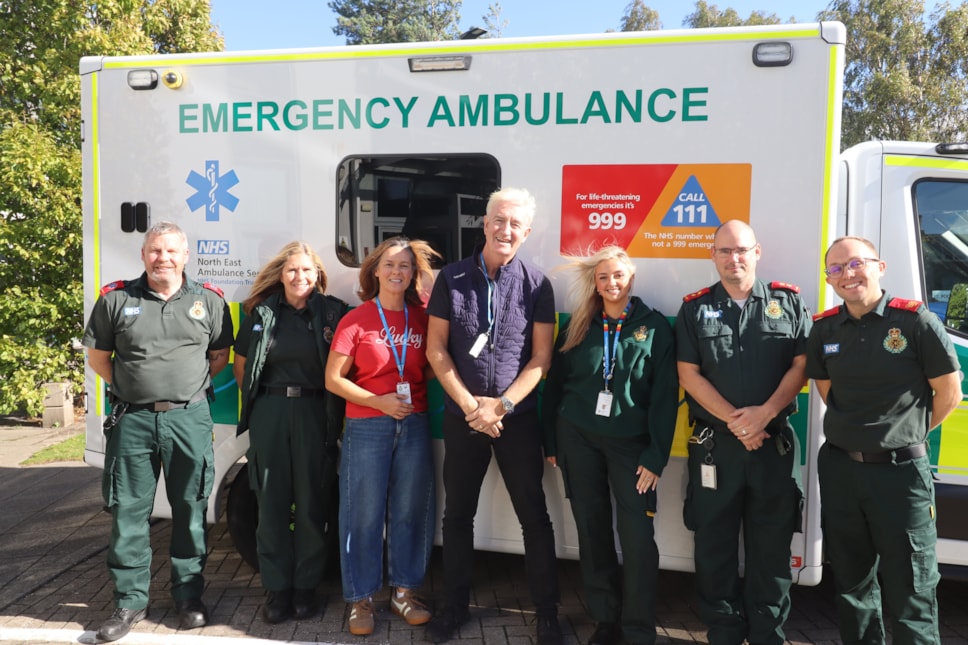
Patient reunited with ambulance crew who helped save his life after cardiac arrest at Byker Asda
A North East man who suffered a cardiac arrest while buying his lunch has been reunited with the ambulance service colleagues who helped save his life – after a remarkable chain of events gave him a chance of survival.
Roger Crosby, who was 56 at the time, had been at work since 6am on 8 May and was looking forward to playing golf later that day. He had no idea that a trip to buy a sandwich would almost cost him his life.
Roger, from Bellingham, had been virtually symptom-free in the weeks before his cardiac arrest and had even undergone an ECG the night before, which had shown no concerns. But just hours later, while inside Asda in Byker, Roger suddenly collapsed. He said: “I had been under a lot of stress and I was exhausted, but I had never had high blood pressure. I think my cholesterol had crept up. I had an ECG the night before and it was clear. I went to work, went to Asda for my lunch and then woke up two days later in the Freeman having had a stent fitted.”
Roger’s survival depended on a remarkable chain of events. He wasn’t alone when he collapsed. A medical student, who happened to be in the store at the time, immediately started CPR and stayed to help the emergency teams. The store had a defibrillator which could be used before the ambulance crew arrived. And, crucially, Roger was in Byker, close to the Freeman Hospital, where he could receive the specialist treatment he needed.
In 2025/26, North East Ambulance Service answered more than 1.475m emergency 999 and NHS 111 calls, with more than 298,000 patients taken to hospital, more than 56,000 patients treated and discharged over the phone and more than 143,800 patients treated and discharged at home. It responded to more than 40,444 C1 serious and life-threatening incidents – including cardiac arrests – in an average time of 6 minutes 17 seconds.
Roger’s cardiac arrest was reported to NEAS at 12.06pm. Health advisor, Ebony Tweddle, took the emergency call, while dispatcher officers, Erin Denyer and Jennifer Alexander, helped coordinate the response. An ambulance crew from Howdon station, including ambulance support practitioner, Claire Shearer, and paramedic, Iain Shaw, arrived at 12.10pm; just four minutes after the call was received.
Ebony said: “Taking a call like this is very different to any other 999 call. You know that the person on the other end of the phone is in a life-threatening situation and every second matters. Talking someone through CPR and helping them find and use a defibrillator while you know an ambulance crew is on its way can be incredibly intense. You’re trying to keep the caller calm and focused while giving them the instructions they need to help keep someone alive.
“You never know what the outcome will be once that call ends, so to now see Roger doing so well and hear about his recovery is really special. Knowing that the instructions given over the phone helped play a part in getting him to this point is something I’m incredibly proud of.”
Specialist paramedic critical care, Thomas Mortillaro, arrived shortly afterwards and provided specialist critical care alongside the ambulance crew. A clinical team leader, Dustin Norris, also attended, while police officers provided additional assistance at the scene, including CPR and helping the ambulance team access equipment.
Despite being in cardiac arrest for a significant period of time, the team was able to restore Roger’s circulation. He was then taken to the Freeman Hospital, arriving at 1.28pm, where he underwent a procedure to insert a stent.
Paramedic Iain Shaw said: “It was a really serious situation when we arrived, so to have the opportunity to see Roger again now, standing on his own two feet and looking so well, is fantastic. You see people on some of the worst days of their lives, and you don’t always get to find out what happens to them afterwards. Being able to meet Roger again and hear about everything he has gone on to do since that day really brings home why we do this job.
“It’s brilliant to see him back on his feet, talking about his family, his music and getting back to doing the things he enjoys. It’s a reminder of just how important every part of that response can be.”
Roger said the care he received from the NHS has been “incredible” and that his recovery has been better than he could have imagined. He said: “The whole wraparound care from the NHS has been incredible. My recovery has been amazing. I play in a rock and roll band, so I’m really pleased to be back doing the things I love.”
Dad of three, Roger, was keen to meet the people who played a part in saving his life and thanking them personally.
Thomas Mortillaro said: “It was fantastic to see Roger again. When we first saw him, he was critically unwell, so seeing him now, looking so well and getting back to his normal life, is a brilliant outcome. Roger’s story is a really good example of how things can go right when somebody suffers a cardiac arrest and they receive the right treatment at the right time.
“He had people around him who recognised what was happening and started CPR, there was a defibrillator available, our crews were able to get to him quickly and provide advanced treatment, and he was able to get to hospital for the specialist care he needed. That whole chain made a difference.”
The reunion comes just days before Restart a Heart Day on Thursday 16 October, which aims to raise awareness of cardiac arrest and encourage people to learn CPR and how to use a defibrillator.
Roger said his experience has shown him just how quickly an ordinary day can become a matter of life and death. He said: “It can happen to anybody. I had virtually no symptoms and I was just going about my normal day. If people know what to do in an emergency, it can make such a difference.”
In September, Roger’s sons Daniel and James ran the Great North Run in aid of the British Heart Foundation in order to raise awareness of what happened to their dad earlier in the year.
Thomas continued: “Roger’s story shows the incredible difference that can be made when a whole chain of survival comes together. We hope his story encourages people to learn CPR and how to use a defibrillator. You never know when you might be the person who needs those skills or when they might help save someone you love.”